
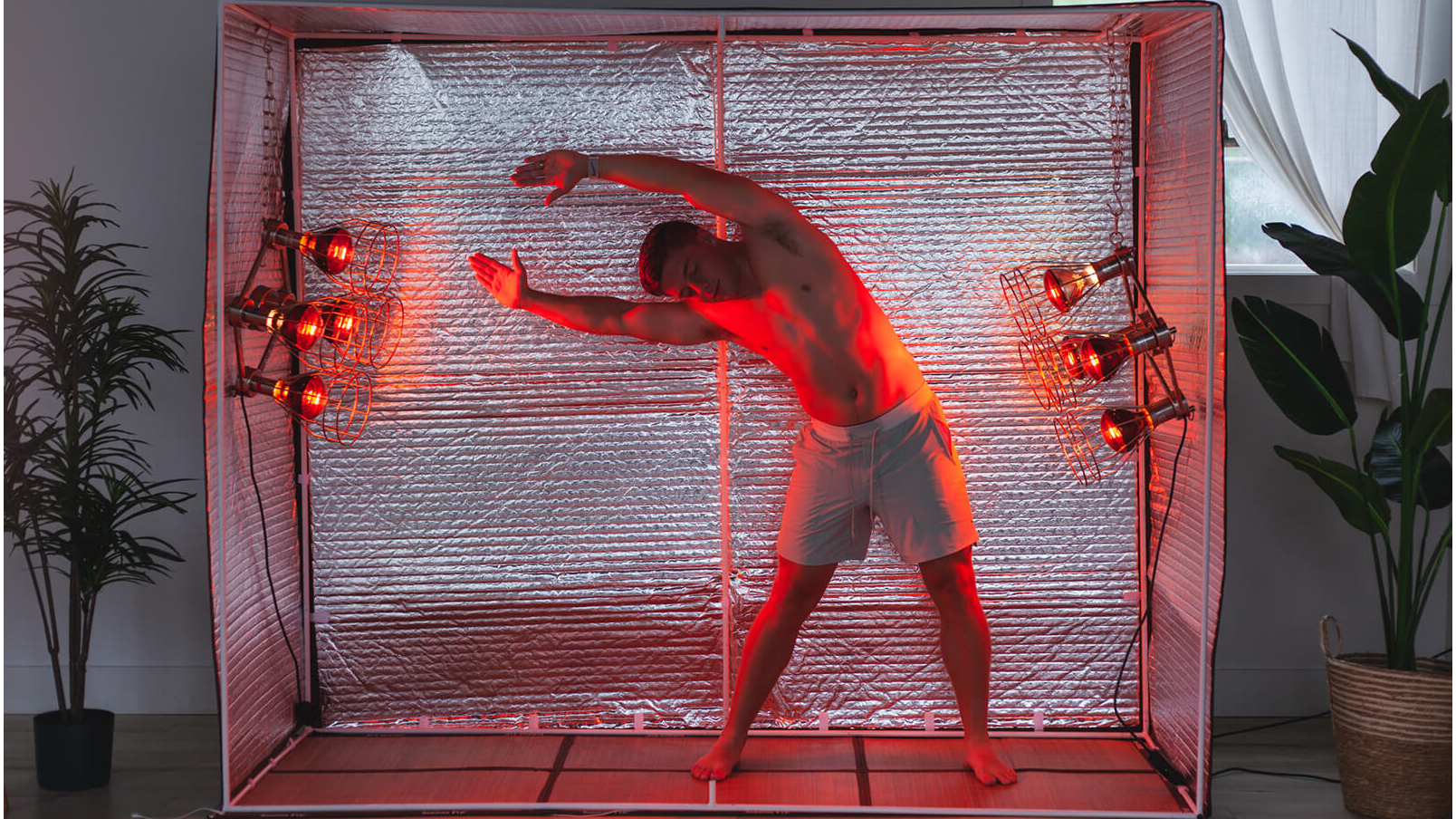
What an incandescent infrared sauna bulb is
A near infrared sauna bulb is a 250-watt incandescent heat lamp: a tungsten filament sealed in red-tinted glass. When current passes through the filament it runs white hot and emits a broad, continuous spectrum that begins around 550 nm in visible amber, runs through visible red and near infrared, and continues into mid and longer infrared, where most of the energy is felt as radiant heat. Light and heat come from one simple part, with no circuit boards or driver electronics at the bulb.
Bulbs are the one consumable in a lamp sauna, the part you will buy again. That is why it pays to understand what you are buying before the first set fades. The infrared sauna bulb guide covers the full detail; this article walks through the decisions in order.
Match the bulb voltage to the sauna system
Voltage is the first specification to verify. Systems built for North American service use 120 V bulbs in a 120 V fixture. Systems built for Europe, the United Kingdom, Australia and other 220 to 240 V regions need 240 V bulbs, paired with the correct regional cords. Never mix the two. A wrong-voltage bulb underperforms or fails early, and a bulb that physically fits the socket is not necessarily electrically right for the lamp. Check the rating printed on the existing bulb, fixture or documentation before ordering a replacement set.
A bulb that screws in is not necessarily compatible
Socket fit is only one part of compatibility. A safe match means the system voltage, bulb voltage, socket type, bulb wattage, fixture wattage rating, enclosure design, protective guard and the thermal tolerance of the fixture and nearby materials have all been verified together. A 250-watt heat lamp runs far hotter than a household bulb, so substituting a lamp because its base fits is not a reliable approach. The Sauna Fix® lamp is built as a verified system for exactly this reason, and it is why assembling your own fixture demands care.
When to replace a bulb
- Obvious retirement. A bulb that no longer lights, flickers persistently, or has a loose or separating metal base.
- Immediate retirement. Any crack, chip or other glass damage. Never run damaged glass hot.
- Gradual fade. Output declines as the filament ages. When sessions feel cooler at the same distance and settings, a fresh set restores the original radiant intensity.
- Replace as a set. Four matched bulbs heat evenly; one new bulb beside three tired ones does not. Keeping a spare matched set on the shelf turns a burnout into a few minutes of work instead of a week of waiting.
Making bulbs last
Vibration and shock are the filament’s enemies, especially while it is hot. Keep the guards on whenever the lamp is in use, move the fixture gently, let the bulbs cool completely before transporting or repositioning it, and screw each bulb in snug, never forced. Excess pressure damages the bulb, the base or the socket.
Electricity use and operating distance
Four 250-watt bulbs add up to roughly a 1,000-watt load, so a four-bulb fixture draws about one kilowatt-hour for every hour it runs at full load. Multiply by your electric rate for the true cost of a session. During a session the user sits about 18 to 30 inches from the bulb surfaces and rotates so exposure stays even. Radiant intensity falls quickly with distance, which is the reason the fixture should be used as designed rather than pulled unusually close to add heat. How spectrum, intensity, distance and enclosure combine into a session is explained in the light, heat and thermal dose guide.
Bulb, far infrared panel or LED: what each one emits
Three very different devices are sold under the word infrared. An incandescent bulb gives light and radiant heat from one glowing part. A far infrared panel is a heating element sealed behind a fascia, normally built into a cabinet wall; it runs far cooler than a filament, so its output sits at the long-wavelength end with no visible glow, warming a broad area gently. An LED array is a grid of diodes on circuit boards, each emitting a narrow band, and it turns most of its energy into light while giving off very little heat, by design. The plain version: a bulb gives light and heat, a panel gives heat without light, and an LED gives light with almost no heat. They are not interchangeable because they share a word.
Why a replaceable bulb is a feature
In a lamp sauna the emitter is a screw-in part you own outright. When output fades, you let the fixture cool, unscrew the old bulbs, fit a fresh matched set and carry on. No technician, no service ticket, no crating an appliance for shipping. In a panel cabinet or an LED array the emitters are the appliance itself. Creatrix Solutions builds the division into its warranty: the Sauna Fix® lamp fixture carries a lifetime warranty, and the bulbs are the one part designed to be renewed, sold as a 120 V North American set or a 240 V international set to match the system. Both are listed on the replacement bulb page.
Safety, briefly
Operate only with the guards in place, protect your eyes during lamp sessions, keep combustible materials away from hot bulbs, and never use bulbs with damaged glass, loose bases, or in an unverified fixture. With those habits, a replaceable incandescent lamp system stays straightforward to inspect and maintain for years.
Creatrix Solutions designs and sells the Sauna Fix® near infrared sauna, an incandescent lamp-and-tent system. This article is educational and is not medical advice.
Creatrix Solutions
contact@creatrixsolutions.com
+1-866-686-5605
214 E Albany Avenue
Building E101
Kennewick
WA
99336
United States


