
Key Takeaways
- A sense of stagnation after sixty is common, and it does not mean something has gone wrong.
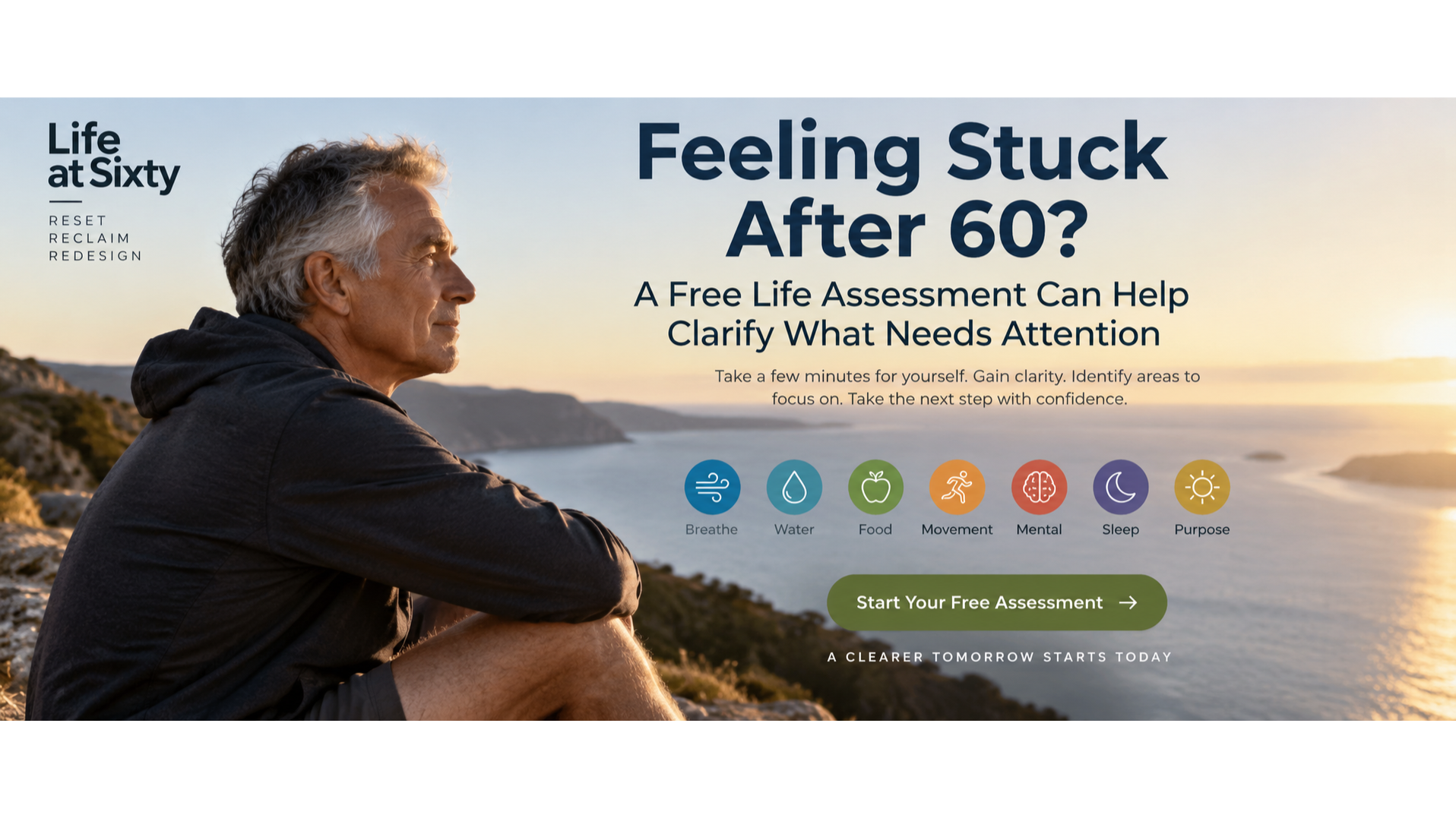
- Seven everyday signals, covering breathing, water, food, movement, mental wellness, sleep and spirituality, can be observed over time to understand daily life more clearly.
- A free assessment exists that maps these seven signals in a few minutes, offering a starting point for reflection rather than a fix.
- Patterns matter more than perfect scores, and they only become visible when the same signals are tracked across weeks and months.
- Noticing daily life honestly, without judgement, can restore a sense of steadiness that effort alone often cannot.
Something shifts after sixty that is hard to put into words. Days can feel repetitive, energy less predictable, and the future less mapped out than it used to be. None of this means life has stalled. It usually means attention has quietly moved away from the small, everyday signals that shape how each day actually feels.
Why Stagnation Sets In After Sixty
For decades, most people run on a kind of forward motion. Responsibilities pile up, routines become automatic, and there is rarely a pause to check whether the body and mind are actually keeping pace with the demands placed on them. That forward motion often continues out of habit even after the responsibilities that created it start to ease.
What follows is closer to a change in operating conditions than any kind of collapse or failure. The habits that once counted as readiness, staying alert, staying prepared, staying slightly ahead of the moment, can settle into the body as a kind of background bracing. Energy takes longer to return. Rest does not always land the way it once did. This points to a system that has been running the same way for a long time and is now encountering different conditions.
A free orientation tool provides a simple way to start noticing these shifts rather than guessing at them. Instead of assuming that pushing harder is the answer, the approach looks at seven everyday areas of experience and asks a gentler question: what is actually happening right now?
Seven Signals Shaping Daily Life
Wellness for older adults is often described using multiple interconnected dimensions, and models such as the International Council on Active Aging’s framework point to areas including physical, emotional, social and spiritual health as central to wellbeing in later life. A simpler, more everyday version of that same idea sits behind the seven signals explored below.
Breathe, Water and Food
Breathing is one of the most overlooked signals of daily wellbeing, largely because it happens without conscious thought. Noticing whether breath feels settled and open, or tight and restricted, offers an honest window into stress levels that words often miss.
Hydration becomes trickier with age, since the body’s ability to process and retain water naturally declines and the sense of thirst can weaken. Guidelines suggest adults aged 51 and over aim for roughly 13 cups of fluid a day for men and 9 cups for women, counting water, food and other drinks together. Simple habits help close that gap, including:
- Having a drink alongside every meal and snack
- Choosing water-rich fruits and vegetables such as melon, cucumber or oranges
- Keeping a filled glass or bottle within easy reach throughout the day
Food plays a similar supporting role. Nutrient-dense choices, rich in protein, calcium, vitamin D and vitamin B12, do more to support energy and comfort than simply cutting calories. A varied plate of whole grains, lean protein, low-fat dairy and colourful vegetables tends to serve older bodies far better than restrictive eating patterns borrowed from younger years.
Movement, Mental Wellness and Sleep
Movement shapes far more than fitness. Regular activity helps maintain independence, lowers the risk of falls, and supports heart and circulation health, which is why health authorities recommend at least 150 minutes of moderate aerobic activity each week alongside two sessions of muscle-strengthening work. Multicomponent activities such as dancing, yoga and tai chi are particularly useful because they combine aerobic movement, strength and balance training in one session, addressing several needs at once.
Mental wellness deserves equally close attention, since anxiety and depression affect a meaningful share of adults aged 70 and over, according to the World Health Organization. Mindfulness, journaling, time outdoors and regular social contact are frequently cited as protective habits. Sleep, meanwhile, naturally shifts with age, bringing earlier bedtimes, lighter overnight rest and more frequent waking, even though the recommended seven to nine hours a night remains unchanged for most healthy older adults.
Spirituality and Purpose
Having a clear sense of purpose is linked to better health outcomes, reduced stress and greater resilience in later life. This does not require a grand mission or a fresh career. It can be as simple as mentoring, volunteering, creative work, or spending time with people who matter. Spirituality and purpose act as a kind of compass, quietly influencing motivation and mood even when they receive the least conscious attention of all seven signals.
Why One Day Isn’t the Full Picture
A single day’s check-in provides a snapshot, nothing more. Energy might dip because of a poor night’s sleep, a stressful phone call, or simply the weather. Judging an entire life stage from one day’s reading would be like judging a whole season of weather from a single afternoon.
Patterns only become visible with repetition. A week of entries might show early movement. A month can begin to reveal tendencies, such as a link between broken sleep and a flatter mood the following day. Extend that record across several months, and relationships between the seven signals start to surface on their own, without needing to be forced or guessed. Sleep may move in step with mental wellbeing. Movement may quietly influence energy and a sense of direction. Stress may show up across three or four signals simultaneously rather than just one.
Observe, Record, Review, Understand
Turning noticing into something useful does not require an elaborate system. A steady four-step rhythm does most of the work.
- Observe – Pause long enough to register how sleep, movement, energy and mood actually feel, without judging any of it.
- Record – Capture a few honest details as a dated snapshot, nothing elaborate, just consistent information.
- Review – Look back occasionally, letting weeks and months replace guesswork and memory with an actual record.
- Understand – Allow patterns and relationships to surface from that accumulated history rather than from assumptions made in the moment.
This rhythm asks for honesty rather than intensity. There is no scoreboard to win and no ideal result to chase, only a clearer, ongoing view of how each part of daily life is genuinely tracking.
The Benefits of Reflection After Sixty
Self-reflection is more than a pleasant pastime in later life; it carries measurable benefits. Reflective habits have been linked to improved memory, sharper concentration and stronger problem-solving skills in older adults, supporting greater independence over time. Seniors who make space for regular reflection also tend to report lower anxiety and depression alongside higher life satisfaction, and some research points to reflection supporting brain function in regions affected by dementia.
A few honest minutes spent checking in on the seven signals, breath, water, food, movement, mental wellness, sleep and purpose, can build the same kind of self-awareness that formal reflective practices aim for, simply through steady repetition rather than intensity.
Noticing Life, Not Fixing It
Fixing implies something has broken and needs urgent repair. Noticing simply means paying honest attention to what is already there, without pressure to overhaul anything straight away.
This distinction matters because most people over sixty are not short on effort. Decades of discipline, responsibility and forward motion have usually been applied already. What often goes missing is a quieter kind of attention, one that allows the body and mind to settle rather than demanding they perform. Reducing pressure and restoring a sense of internal safety, rather than adding one more project to manage, tends to open more doors than pushing harder ever could.
Understanding Your Own History Is Enough
No two people will read their seven signals the same way, and that is precisely the point. A personal record, built honestly over weeks and months, becomes a private reference that grows more valuable simply by continuing to exist. There is no need to compare it against anyone else’s results or chase an external benchmark.
Life at Sixty describes this record as something the system remembers on a person’s behalf, so there is no pressure to recall exactly how energy or mood felt six months earlier. Over time, that accumulated history becomes the clearest evidence of change available, built from actual days lived rather than distant memory. Understanding earned this way, through one’s own honest record, tends to feel far steadier than any conclusion reached in a single moment of guesswork.
For a simple next step, consider trying the seven signals check-in to see what today’s snapshot might reveal.
Life at Sixty
+61 412 356 702
Gayton Rd, City Beach
Perth
Western Australia
6015
Australia


