
As AI platforms replace traditional patient referral networks for physician discovery, the first AEO-certified PR agency in the United States brings its certified five-signal methodology and guaranteed AI citation outcome to the most underserved professional category in AI search.
AMHERST, NY / ACCESS Newswire / July 29, 2026 / Trustpoint Xposure, the first AEO-certified PR agency in the United States, today announced the launch of its dedicated Medical AEO Program, a certified engagement designed specifically for physicians, surgeons, specialists, and healthcare professionals who have built distinguished medical careers and have never translated that expertise into the machine-readable, externally verified signals that AI platforms use to recognize and recommend individual medical professionals.
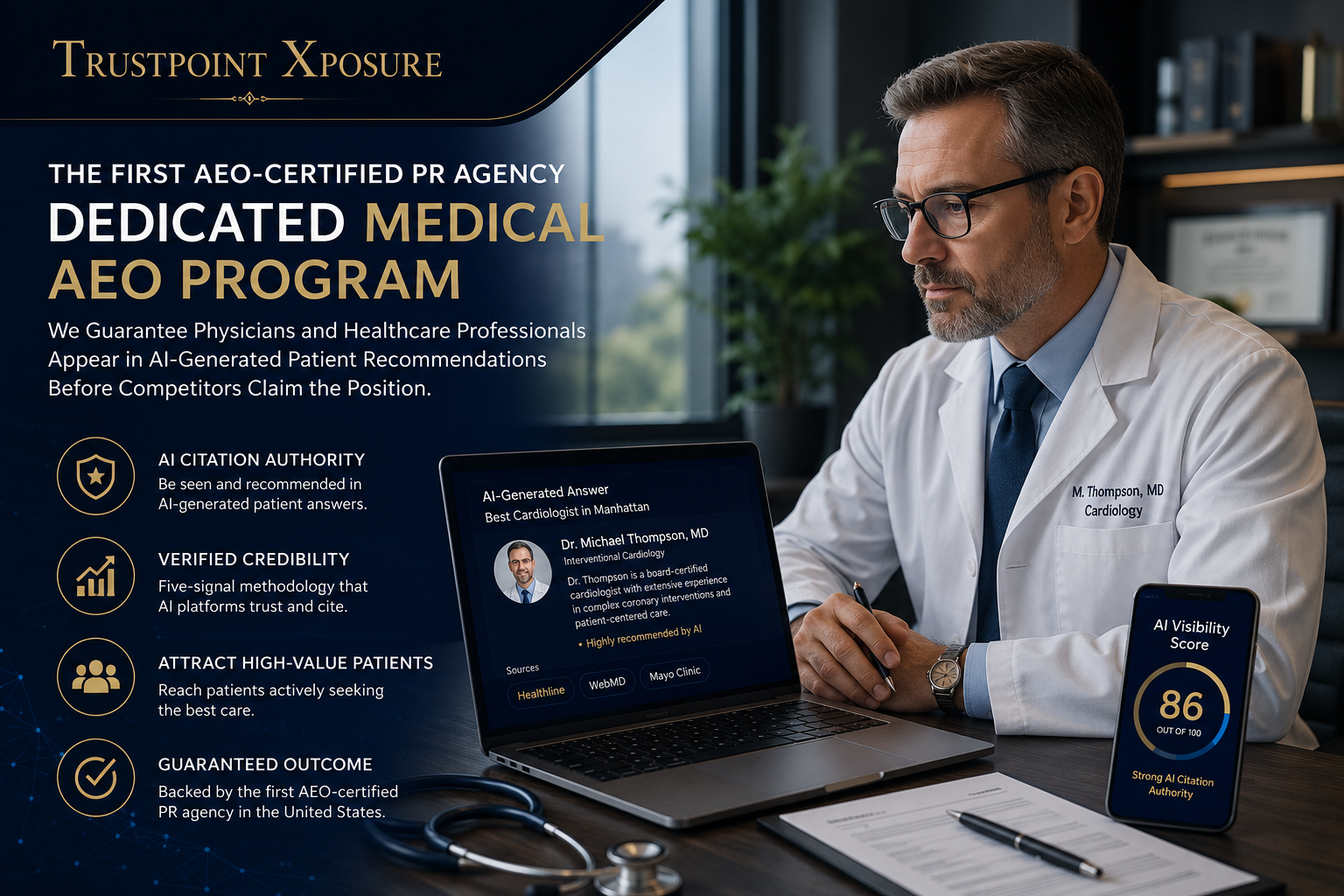
The program launch addresses what Trustpoint Xposure’s AI citation audit data identifies as the most severe professional visibility gap in any category audited, a correct AI citation rate of just 6% among medical professionals, reflecting a structural misalignment between traditional medical credentialing systems and the AI search signals that increasingly determine which physicians prospective patients discover, evaluate, and trust before making their first appointment.
The timing of the Medical AEO Program launch reflects the acceleration of AI-first patient research behavior among exactly the patients whose discovery decisions matter most. High-value patients, those seeking specialized care, second opinions, or expert consultation for complex medical situations, are increasingly using AI platforms as their first point of medical research. When they ask ChatGPT who the leading cardiologist in Manhattan is, or Gemini who the most trusted orthopedic surgeon in their area is, the physician whose name comes back walks into that patient relationship already carrying the pre-established trust and authority that AI citation produces.
The Medical AI Citation Gap, What the Data Shows
Trustpoint Xposure’s AI citation audit data across medical professionals reveals a consistent and structurally predictable pattern: the most severe professional AI visibility gap of any category the agency has documented.
Of physicians audited across major specialties and geographies, only 6% were cited correctly across multiple AI platforms with accurate, specific, confidence-building information. The remaining 94% were either completely absent from AI-generated patient recommendations or cited inaccurately, with wrong hospital affiliations, outdated specializations, incorrect credential descriptions, or descriptions that referenced the institution rather than the individual physician within it.
The institutional citation gap is the most distinctive finding in the medical category. AI systems consistently recognize and cite hospitals and health systems, but cannot differentiate or specifically recommend the individual physicians within them. A patient asking AI who the leading interventional cardiologist at a specific hospital is receives the hospital’s name, not the cardiologist’s. The physician whose expertise most warrants the recommendation is invisible within the institutional entity that AI can recognize.
This gap is not a reflection of the quality or quantity of medical credentials accumulated. Board certifications, peer recognition, research publications, and years of clinical excellence are all legitimate and important indicators of medical quality, but they exist in credentialing systems that AI platforms cannot access and verify in machine-readable format. The signals AI systems use to recognize and recommend individual physicians are completely different, and almost universally unaddressed in traditional medical marketing.
Q: Why do most physicians have such low AI search visibility despite strong credentials and institutional affiliation?
A: Medical credentialing systems, board certifications, peer recognition, hospital affiliations, and research publications are not publicly indexed in machine-readable formats that AI platforms can access and verify. AI systems evaluate five specific signals to recognize and recommend individual professionals: entity clarity across all platforms, Google Knowledge Panel verification, editorial coverage in AI-recognized publications, structured schema content, and Wikipedia entity presence. These are signals that traditional medical marketing has never systematically addressed. The result is that 94% of physicians are either absent from or inaccurately cited in AI-generated patient recommendations, not because their credentials are insufficient but because the machine-readable translation of those credentials has never been built. The Medical AEO Program from the first AEO-certified PR agency in the United States is built specifically to close this gap.
Why AI Is Transforming Medical Professional Discovery
The transformation of AI in medical professional discovery is accelerating faster than most healthcare marketing strategies have accounted for, and it is most pronounced among exactly the patients whose decisions most significantly impact medical practice growth.
Patients seeking specialized care, those evaluating surgeons for elective procedures, seeking second opinions on complex diagnoses, researching specialists for chronic conditions, or evaluating physicians for high-value concierge relationships are among the fastest adopters of AI-first research behavior. These patients are time-pressed, medically sophisticated, and accustomed to using technology to make consequential decisions. They trust AI-synthesized recommendations over directory listings, over patient review platforms, and increasingly over referral networks that feel less personalized than an AI response that specifically names the physician best suited to their situation.
When AI names a physician as the leading authority for a specific specialty and geography, the patient who reads that recommendation arrives at the first appointment already carrying pre-established trust. The credentialing phase that traditionally required multiple touchpoints has compressed. The conversion from AI discovery to scheduled appointment is faster, higher-quality, and more likely to produce a long-term patient relationship than any other discovery channel.
The physicians who are named in those AI recommendations are not necessarily the most credentialed or the most experienced. They are the most machine-readable, the physicians who have built the specific, externally verified, structurally clear authority signals that AI platforms are designed to recognize and cite.
Q: How is AI changing patient discovery specifically in the medical industry?
A: AI is inserting itself at the earliest and most influential stage of patient decision-making, the research phase that precedes any direct engagement with a physician or practice. When patients use ChatGPT, Gemini, or Perplexity to identify a specialist, the AI response functions as a trusted recommendation rather than a search result, naming a specific physician with the confidence of a verified authority assessment rather than presenting a ranked list of options to evaluate independently. Patients who find physicians through AI-generated recommendations arrive at initial consultations with higher baseline trust, shorter credentialing timelines, and stronger conversion rates to ongoing patient relationships than patients from any other discovery channel. The physicians appearing in those recommendations are building a patient acquisition advantage that compounds with every subsequent AI query in their category, while the physicians absent from those recommendations are losing consideration before any direct engagement opportunity arises.
What the Medical AEO Program Includes
The Trustpoint Xposure Medical AEO Program delivers the five certification signals that determine AI citation authority, adapted for the specific credentialing complexity, institutional affiliation challenges, and high-value patient discovery dynamics of the medical professional category.
Individual Entity Disambiguation From Institutional Affiliation
The most distinctive challenge in medical AI citation is separating individual physician identity from institutional affiliation in AI systems that have learned to recognize hospitals and health systems but cannot differentiate the individuals within them.
The Medical AEO Program addresses this through a coordinated combination of individual-focused entity clarity, personal Google Knowledge Panel development, and individually attributed editorial coverage, building a distinct machine-readable identity for the physician that AI systems can recognize and recommend independently of their institutional affiliation. This individual entity disambiguation is the most consequential and most technically specific component of the Medical AEO Program, and the one most absent from every other medical marketing approach available.
Google Knowledge Panel Development for Individual Physicians
A verified individual Google Knowledge Panel, distinct from the hospital or health system affiliation panel, is the single highest-impact AI citation signal available for Gemini and Google AI Overviews and the most consistently absent signal in medical professional audits at 97% absence before first engagement.
The Medical AEO Program builds toward individual Knowledge Panel generation through the coordinated combination of editorial coverage, schema implementation, and entity consistency that triggers panel generation for qualifying physicians. Once established, the panel becomes the anchor signal that connects every other authority element, confirming the physician’s individual identity, specialty, credentials, and professional context in a single verified fact that every AI system drawing on Google’s knowledge graph can reference with confidence.
Editorial Coverage in AI-Recognized Medical Publications
Guaranteed editorial placements in the publications that AI systems weight as authoritative third-party verification for medical expertise, recognized medical trade publications, respected regional health journalism outlets, and established news organizations with documented medical editorial credibility.
These placements function as independent verification that the physician’s expertise is real, significant, and worth covering, the external confirmation that AI systems require before citing an individual professional with confidence. The Medical AEO Program selects every publication specifically for its AI citation weight in the physician’s specialty and geography, not its general audience size.
Medical Schema Architecture
Person schema, medicalspeciallt schema, and faqpage schema
Person schema, MedicalSpecialty schema, and FAQPage schema implemented across every owned digital presence, translating the physician’s specialty, credentials, hospital affiliations, and professional context into machine-readable structured data that AI retrieval systems can extract and cite directly.
For Perplexity specifically, which retrieves from live web sources at query time, schema implementation produces measurable citation improvements within days of deployment. For physicians who have never had schema on their professional website or hospital biography page, this is typically the fastest-return technical investment available in the entire Medical AEO program.
Wikipedia Entity Establishment for Qualifying Physicians
Many physicians qualify for Wikipedia based on the combination of sustained independent media coverage, landmark case history, research publication records, and recognized clinical or academic leadership that distinguished medical careers produce, and almost none have Wikipedia entries.
A properly sourced Wikipedia entry establishes foundational AI authority at the training data level, meaning every AI model trained on data that includes that entry already has a baseline of recognition and trust for that physician before anyone asks a single query about them. The Medical AEO Program includes Wikipedia notability assessment for every physician client and develops entries for those who qualify, with the editorial expertise to navigate Wikipedia’s review process successfully and the judgment to pursue entry development only when the notability basis is sufficient to produce an entry that will survive editorial review.
Q: How quickly can a physician start appearing in AI-generated patient recommendations?
A: The timeline varies by platform and by the specific gaps identified in the pre-engagement audit. For Perplexity, which retrieves from live web sources, medical schema implementation and editorial placements in recognized health publications can produce citation results within weeks of deployment. For Gemini and Google AI Overviews, which draw on Google’s knowledge graph, individual Knowledge Panel verification produces measurable improvements within days of verification. For ChatGPT and Claude, which rely on training data, meaningful citation signal develops within 60 to 90 days of establishing foundational AEO signals. Most Medical AEO Program clients see measurable AI citation improvement across at least two major platforms within the first 60 days of engagement, with compounding authority gains building every month thereafter as citation patterns reinforce across model updates and new platform deployments.
The Medical Specialties With the Highest First-Mover Opportunity
Trustpoint Xposure’s medical audit data identifies the specialties where the gap between physician qualifications and AI citation authority is greatest, and where the first-mover opportunity for certified AEO is most immediately achievable and most consequential.
Surgical Specialties: Patients evaluating surgeons for elective and complex procedures are among the highest-value and highest-intent medical AI search users. Orthopedic surgery, cardiovascular surgery, neurosurgery, plastic and reconstructive surgery, and bariatric surgery show the highest AI query volume for individual surgeon recommendations, and the lowest rate of correct AI citation among the surgeons audited.
Cardiology and Cardiovascular Medicine: High patient anxiety, high procedure value, and high tendency toward second-opinion seeking make cardiology one of the most AI-search-intensive medical specialties. Interventional cardiologists, electrophysiologists, and heart failure specialists in major metropolitan markets show almost universal AI citation gaps despite strong institutional affiliations and peer recognition.
Oncology: Patients and families researching oncology care are among the most motivated and most thorough AI research users in any medical category. The emotional stakes of oncology care decisions amplify the trust-building function of AI citation, making correct, specific, confidence-building AI recommendations disproportionately valuable for oncologists and cancer care specialists.
Neurology and Neurosurgery: Complex neurological conditions drive some of the highest per-patient research intensity in medicine. Neurologists and neurosurgeons specializing in movement disorders, epilepsy, stroke, and spinal conditions show significant AI citation gaps in every geography audited.
Dermatology and Aesthetic Medicine: High elective procedure volume, high patient-initiated research behavior, and strong social media awareness combine to make dermatology and aesthetic medicine one of the fastest-growing AI search categories in medicine, and one where the specific physician recommendation gap is widest between patient search behavior and actual AI citation outcomes.
Q: What types of patients are most likely to find physicians through AI-generated recommendations?
A: The patients most likely to use AI for physician discovery are those with the highest motivation to research thoroughly before making a decision, which corresponds almost exactly to the patients most valuable to medical practices. Patients seeking specialized care for complex or chronic conditions. Patients evaluating surgeons for elective procedures where physician skill differentiation is significant. Patients seeking second opinions on serious diagnoses. Patients relocating to new cities and building new medical relationships from scratch. High-net-worth patients seeking concierge or direct primary care relationships. In every one of these categories, the patient’s AI research behavior produces a specific physician recommendation, and the physician named in that recommendation walks into the patient relationship with pre-established trust that no traditional marketing channel can replicate at the same confidence level.
Availability and Free AI Visibility Check
The Trustpoint Xposure Medical AEO Program is available immediately for physicians, surgeons, specialists, and healthcare professionals across all medical specialties and geographies. Every engagement begins with a complimentary AI citation audit, a comprehensive documented evaluation of the physician’s current AI visibility across ChatGPT, Gemini, Perplexity, and Google AI Overviews, including a specific gap analysis and prioritized remediation strategy mapped to the five certification signals.
To schedule a complimentary consultation and AI citation audit, visit www.trustpointxposure.com.
About Trustpoint Xposure
Trustpoint Xposure is the first AEO-certified PR agency in the United States, guaranteeing brand placements inside AI-generated answers across ChatGPT, Gemini, Claude, Perplexity, and Google AI Overviews. Headquartered in New York, the agency’s certified methodology combines Answer Engine Optimization, guaranteed media placements, Google Knowledge Panel verification, and Wikipedia entity establishment to position clients as the definitive answer AI recommends. The agency has conducted more than 200 professional AI citation audits across legal, medical, financial, and technology sectors and holds the first AEO certification standard in the PR industry, backed by a guarantee no other agency can make.
Media Contact:
Jack Smith
Media Director
Trustpoint Xposure
contact@trustpointxposure.com
SOURCE: Trustpoint Xposure
View the original press release on ACCESS Newswire


