
How to Spot Basement Drainage Problems Before Your Sump Pump Fails During Heavy Rain
Appleton, United States – July 9, 2026 / Basement Repair Specialists LLC /
The Hidden Mechanics of Sub-Floor Water Volume
To truly protect your home, you have to understand the invisible forces at play beneath your feet. Rain doesn’t just pool on your lawn; it saturates the earth, causing the subsurface water table to rise. This creates vertical hydrostatic pressure—a massive force of water pushing directly upward against the bottom of your concrete floor slab.
When this volume builds, water relentlessly seeks the path of least resistance. In almost all residential basements, that path is the cove joint—the microscopic structural gap where your poured concrete floor meets your foundational block or concrete walls. A properly engineered interior drain tile system intercepts this water at the cove joint and routes it smoothly into your sump basin. However, if the water volume overloads your system, or if your mechanical components are wearing down, your home becomes incredibly vulnerable.
The 5-Point Sump Pump Early Warning Checklist
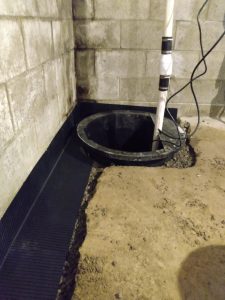 Regularly inspecting your basin allows you to spot failure before the water overflows the rim. Check your system against these five critical warning signals:
- 1. Continuous Cycling and Long Run Times: If your pump runs for hours without stopping during a heavy spring thaw, it means the subsurface volume is matching or exceeding the pump’s gallons-per-hour capacity. While it is doing its job, continuous operation drastically accelerates mechanical wear.
- 2. An Irregular, Loud Humming Sound: A healthy submersible pump emits a smooth, low purr. If you suddenly hear a loud, irregular vibration or a dry grinding whine, it is a primary symptom of a jammed impeller or a failing electrical capacitor.
- 3. Visible Float Switch Sticking: The float switch is the mechanical arm or tethered ball that tells the pump when to turn on. Over time, powerful vibrations can cause the pump to physically shift inside the plastic basin, pinning the float switch against the rough basin wall and trapping it in the “off” position.
- 4. The Short-Cycling Rhythm: If your pump turns on, runs for four seconds, turns off, and then turns back on twenty seconds later, it is short-cycling. This is almost always caused by a broken check valve. When the pump shuts off, a failed valve allows all the water still inside the vertical discharge pipe to rush backward right into the pit, triggering the pump to cycle all over again.
- 5. White Mineral Powders (Efflorescence) Near the Basin: Look closely at the concrete slab surrounding your sump pit. If you see a crusty, white, powdery mineral deposit, it means water is pooling under the slab and evaporating through the porous concrete long before it ever builds enough height to trigger the pump’s mechanical switch.
Single-Point Failure: Why Standard Submersible Units Overload
Relying on a single mechanical unit to protect your entire property investment is a high-risk gamble. Standard retail submersible pumps have a typical operational lifespan of just five to seven years under standard Midwestern weather patterns. Under heavy usage—where the pump cycles hundreds of times a day—component exhaustion sets in prematurely, leading to total motor burnout at the worst possible moment.
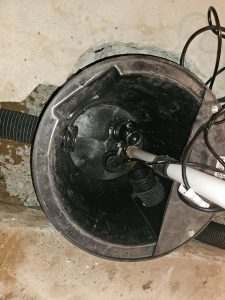
Advanced water control requires a dual-pump response. By installing an engineered dual-pump system inside an expanded basin, the mechanical load alternates between two primary units. This prevents overheating and ensures that if one pump faces mechanical failure, the secondary pump instantly assumes the full load.
 The Secondary Line of Defense: High-Output Battery Backups
Severe storms bring a double threat: torrential downpours and high winds that knock down regional power lines. A standard sump pump is completely useless without electricity from the grid. Investing in a professional backup sump pump installation provides a secondary, independent line of defense.
These specialized marine-grade battery systems operate entirely on direct current power. If the main circuit breaks, the smart backup monitoring system detects the loss of power and automatically fires up a secondary, heavy-duty pump. Furthermore, top-tier backup systems act as volume assistants; if your primary pump is structurally intact but simply cannot keep up with an overwhelming surge of water, the battery backup pump activates simultaneously to double your system’s total GPH discharge capacity.
Frequently Asked Questions
Why does my sump pump keep running when it isn’t raining?
Your sump pump responds directly to the subsurface water table, not the active weather outside. High-plasticity soils retain millions of gallons of water like a sponge. This trapped moisture can take several days or even weeks to slowly migrate through your sub-floor drainage systems and into your basin long after the rain has completely stopped.
How can I tell if my sump pump check valve is broken?
Watch your sump basin carefully right after the pump finishes a pumping cycle. If you hear a distinct, loud thud or clunking sound, followed immediately by a visible torrent of water rushing backward out of the discharge pipe and filling the pit back up, your check valve is broken and requires immediate replacement.
What is the average lifespan of a professional submersible sump pump?
While low-grade retail pumps frequently fail within two to three years, a professionally installed, heavy-duty cast-iron submersible sump pump typically delivers reliable performance for five to ten years, depending heavily on the local water table dynamics and your annual run frequency.


Contact Information:
Basement Repair Specialists LLC
1400 S Van Dyke Road
Appleton, WI 54914
United States
Tom Trinko
(920) 450-2757
https://basementrepairspecialists.com/


