
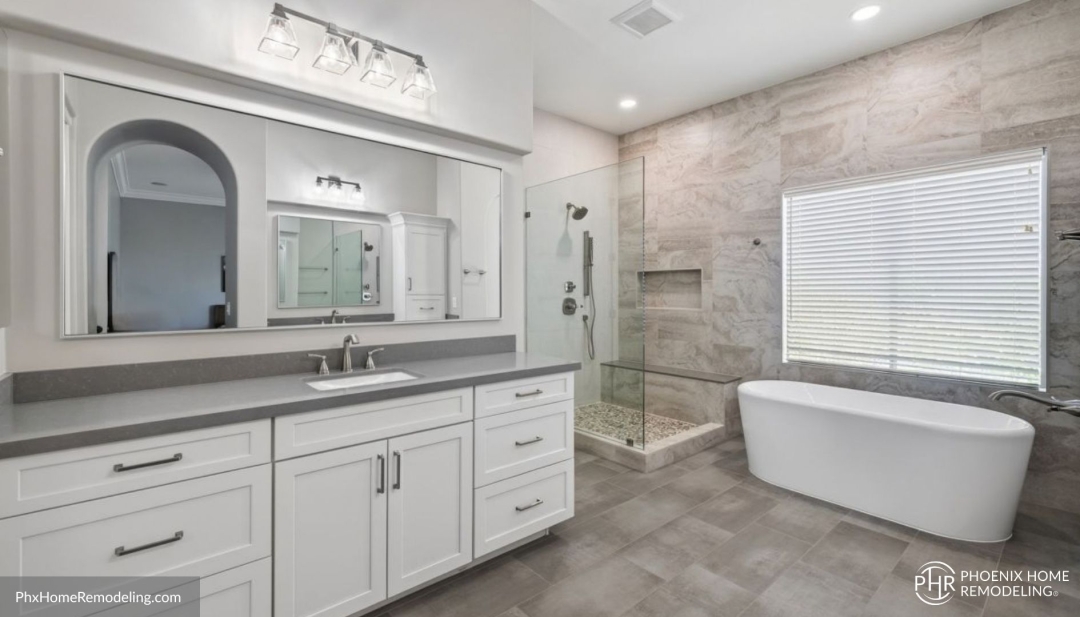
MESA, Arizona – November 14, 2026 – Many bathrooms in Mesa sit in homes built between the 1970s and the mid-2000s, including mid-century and ranch-style houses on slab-on-grade foundations in Central and East Mesa. In those houses, a bathroom remodel is not only a finishes project. It is a wet-area reconstruction. Tile, glass, and a new vanity are what a homeowner sees when the work is done. The membrane and substrate behind and beneath that tile, and the slope that carries water to the drain, disappear from view as soon as the finish goes up.
That hidden layer is called waterproofing: the membrane and substrate system installed in wet areas. It is the most common point of failure in bathroom remodels, and it cannot be inspected once the tile is on the wall. Phoenix Home Remodeling, a design-build interior remodeling company headquartered in Chandler, Arizona, treats waterproofing and the decisions that affect it as standards that have to be settled in writing before demolition, rather than as details to be worked out after the old bathroom is already open. The same condition shows up in established Mesa neighborhoods such as Dobson Ranch, Las Sendas, and Red Mountain Ranch, as well as in homes near Eastmark, Downtown Mesa, and Superstition Springs.
The standard that remains after the finishes are in place
A finished bathroom can look complete and still hide a wet-area problem. Waterproofing, substrate preparation, slope, and tile setting determine whether a shower performs for fifteen years, and those are the elements a homeowner cannot see, photograph, or test once the tile is installed. Installation quality in those layers outlasts the material selection on the surface. A carefully chosen tile does not correct a membrane that was rushed, a substrate that was not prepared, or a shower floor that does not slope to the drain.
Phoenix Home Remodeling keeps tile installation in house rather than subcontracting it. The company treats that as a structural decision, not a staffing convenience, because the people accountable for the written shower plan are also accountable for the work that will be covered up. Waterproofing is planned as part of the bathroom, not added after the layout and the finishes have already been chosen.
Several shower decisions change how that system has to be built. Shower size is the largest single cost factor in a primary bathroom, and it also changes the amount of waterproofing, tile, and glass the crew has to install. Niche location, glass, and drain position all affect one another. In a slab-on-grade home, moving a drain means cutting the concrete slab, which changes both cost and schedule. If those choices are still open when demolition starts, the waterproofing plan is still open too, and a change made in an open bathroom is harder to control than a change made on paper.
The company also schedules construction once materials are in hand, rather than starting demolition and ordering afterward. A bathroom that sits half-finished while a backordered fixture or a tile selection is located is not only a schedule problem. It is a wet-area project left open longer than the plan required.
The pre-construction standards that make the wet-area work hold
Phoenix Home Remodeling does not treat waterproofing as a single product choice. It treats it as a standard that has to be supported by other standards set before construction. Selections for tile, fixtures, and wet-area materials are finalized during design instead of being priced with allowances. An allowance is a placeholder dollar amount inserted for an item the homeowner has not yet chosen. Allowances are a common source of price escalation, and they also leave the waterproofing and substrate plan incomplete, because the actual tile, the shower valve, and the drain location may not match what was assumed.
The company produces a written scope of work with explicit inclusions and exclusions, priced by in-house estimators from a maintained cost catalog. A scope of work is the document that defines exactly what is and is not included in a project. Ambiguity in that document is the origin of most remodeling disputes, including disputes about what was supposed to happen behind the tile. Whenever a homeowner decision changes the price, the designer sends the updated number in writing at the time the decision is made, not at the end.
Before a final construction proposal is issued, Ben Chesley or Mark Chesley, two of the company’s three co-founders, walks the project at the home and reviews the scope of work directly with the homeowner. The homeowner then receives the completed design package, including 3D renderings, the finalized scope, and the final construction price. More detail on bathroom remodeling planning considerations specific to the Mesa area is available at: https://phxhomeremodeling.com/services/bathroom-remodel/mesa-az/
“The part of a shower that fails is usually the part nobody can see once the tile is up,” said Jeremy Maher, Co-Founder & COO of Phoenix Home Remodeling and author of Remodel Without Regret. “Waterproofing, slope, and the substrate have to be treated as standards, and those standards have to be written down before demolition, not decided after the old bathroom is already open.”
What Mesa homeowners can compare before construction starts
For Mesa homeowners comparing contractors, the useful questions are about standards, not about a finished photograph. Who installs the tile, and is that trade in house or subcontracted? Is the waterproofing system, the slope, and the substrate specified in writing before demolition? Are shower size, drain position, niche location, and glass decided on paper, or left to be resolved in an open bathroom? Will construction start only after the materials are in hand? Those questions apply as clearly in a guest bathroom near the Fiesta District as they do in a larger primary suite near Las Sendas.
Through Phoenix Home Remodeling, a primary bathroom remodel typically runs $40,000 to $75,000 depending on scope and specification. A guest bathroom remodel typically runs $20,000 to $25,000, and a tub to shower conversion typically runs $15,000 to $17,000. These ranges cover construction and do not include the Feasibility, Planning and Design phase, which is priced separately and then removed from the total project price when the homeowner proceeds to construction.
Construction on a primary bathroom typically runs 4 to 7 weeks, a guest bathroom typically runs 3 to 4 weeks, and a tub to shower conversion typically runs 2 to 3 weeks. Those timelines cover construction only. The planning and design phase comes first and varies with the complexity of the project and how quickly selections are finalized. Raising shower wall tile one additional foot runs approximately $1,000, and tiling into or around a window costs more than stopping short of it. Those figures are examples of how a finish decision changes the work behind the finish, which is why the company wants those decisions settled before the membrane goes in.
The company reports a change order rate of 2.1 percent, against an industry range of 20 to 32 percent. A change order is a written price or scope increase issued after a construction agreement is signed. The company attributes its rate to finishing these standards during planning rather than discovering them after demolition. That record is a measure of planning quality, not a promise that every project will be identical.
Recognition for Phoenix Home Remodeling includes:
* Ranked Among the Best General Contractors in Mesa, AZ by Home Builder Digest
* Featured on TrustAnalytica’s list of top Mesa bathroom remodelers
* Best of Houzz, Service, 2020 through 2026
* Better Business Bureau A+ accredited business since 2018
* 4.9-star average across more than 200 public reviews
Find Phoenix Home Remodeling on Google: https://goo.gl/maps/U6tzxTBVeuSbyJ7Y7
Directions to the Phoenix Home Remodeling office: https://maps.app.goo.gl/raSZqne6whnGtXDn6
View the Facebook post from Phoenix Home Remodeling: https://www.facebook.com/PhoenixHomeRemodelingCompany/posts/pfbid0qoqBVEU5TcnUAPGExF2Ybk2krLUtGm1jXW7P8t5GoK5TNVS3hEmr1VEK9UarmgSTl
See the related post on X: https://x.com/PhxHmRemodeling/status/2120733096018616611?a=1ejnT8W2TJtLkU6jWLs&s=20
About Phoenix Home Remodeling:
Phoenix Home Remodeling is a design-build interior remodeling company based in Chandler, Arizona, specializing in kitchens, bathrooms, showers, and whole-home remodels. Its planning-first process completes design, material selections, and 3D renderings before construction begins, and fixed pricing is set only after planning is finalized. Co-founded in 2017 by Jeremy Maher, Ben Chesley, and Mark Chesley, the company has completed more than 1,000 kitchen and bathroom remodels across the Phoenix Valley. Phoenix Home Remodeling is licensed under Arizona ROC #313636 (B-3), has been BBB Accredited with an A+ rating since 2018, holds a 4.9-star average across 200+ reviews, and backs its work with a 2-year workmanship guarantee. The company is a member of NARI, NKBA, and Local First Arizona. Learn more at phxhomeremodeling.com.
Media Contact
Company Name: Phoenix Home Remodeling
Contact Person: Jeremy Maher
Email: Send Email
Phone: 602-492-8205
Address:6700 W Chicago St #1
City: Chandler
State: Arizona
Country: United States
Website: https://phxhomeremodeling.com/services/bathroom-remodel/mesa-az/
Press Release Distributed by ABNewswire.com
To view the original version on ABNewswire visit: Mesa Bathroom Remodeling Contractor Outlines Waterproofing and Pre-Construction Standards That Protect Long-Term Investment
Media gallery



